Sunday, September 27, 2015

Chicago to Miami Roadtrip (Day 3)

 Day 3
Destination: Charleston, South Carolina (Hanahan)
Stops: Asheville, NC


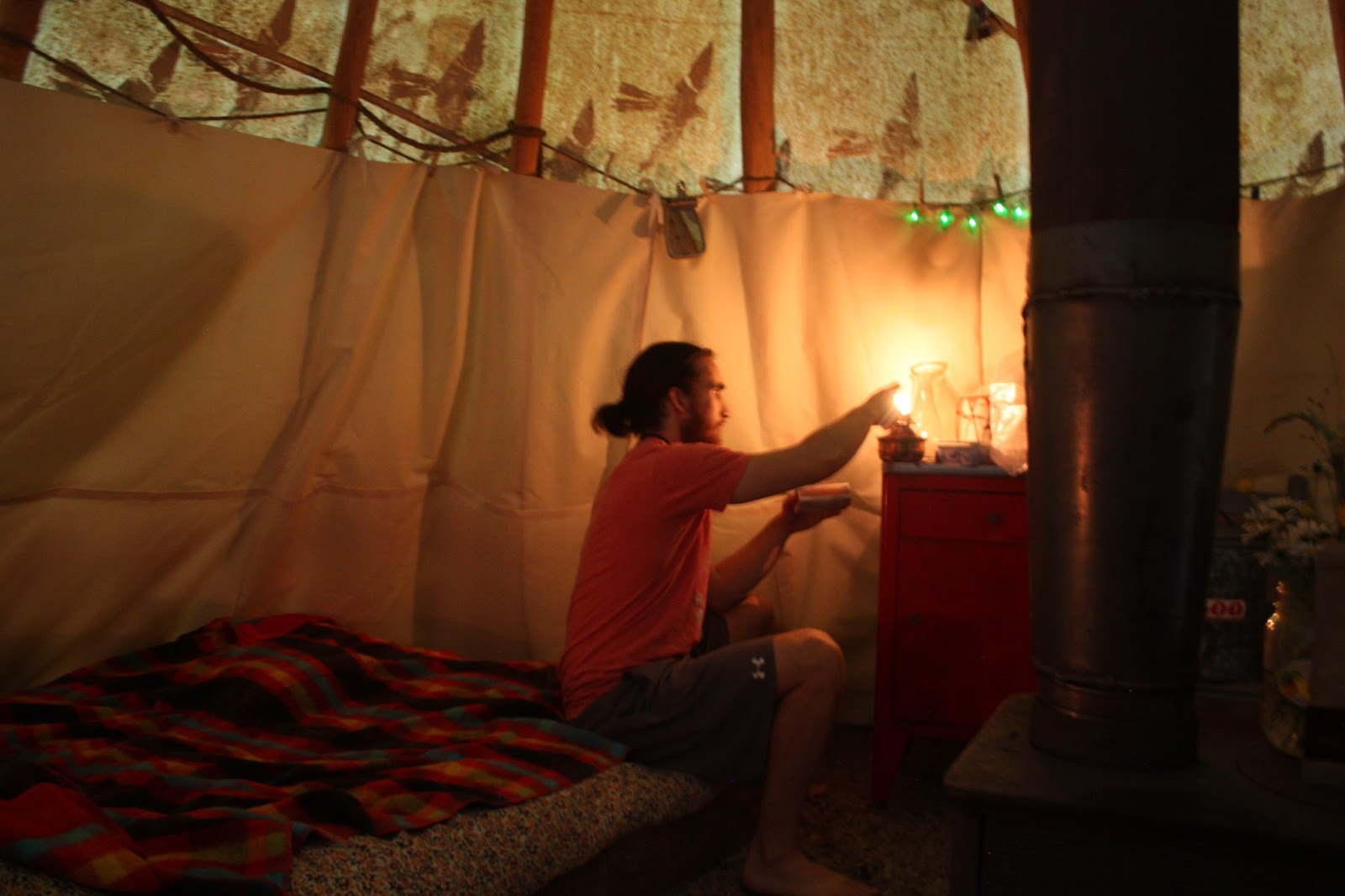
The sound of the creek and rain into the morning was incredible. I loved waking up outside. We had arrived at the tipi shortly before it got dark out, so we used this morning to try to explore the area a little more. We also tried to start a fire in the wood stove; as much as I would like to blame our failure on the dampness of the firewood, that probably isn't completely adequate to explain it... incompetence is probably more like it. Although I really do think we did everything correctly, our fire-starting competence can probably best be described as "I can start a fire if all conditions are perfect... probably." 

I'd give us an A+ for effort. Bandit would give us an F... for everything.


At least we were able to feed you, buddy.
Rosie provides homemade bread, butter, eggs, and most exciting of all, goat's milk. Alex has always wanted to try super fresh milk, which I guess is when you can taste what the goat just ate (grass and dandelions?).

Hmm, looks like someone got something passed under the table. This is Bandit's pretend-like-I'm-not-chewing-when-I'm-chewing face, which he has perfected.
And for the goat's milk experience:
Not sure what that face is about, but we actually really loved the milk. As usual, Bandit is heavily involved in all activities. Here is the area right next to the tipi. 
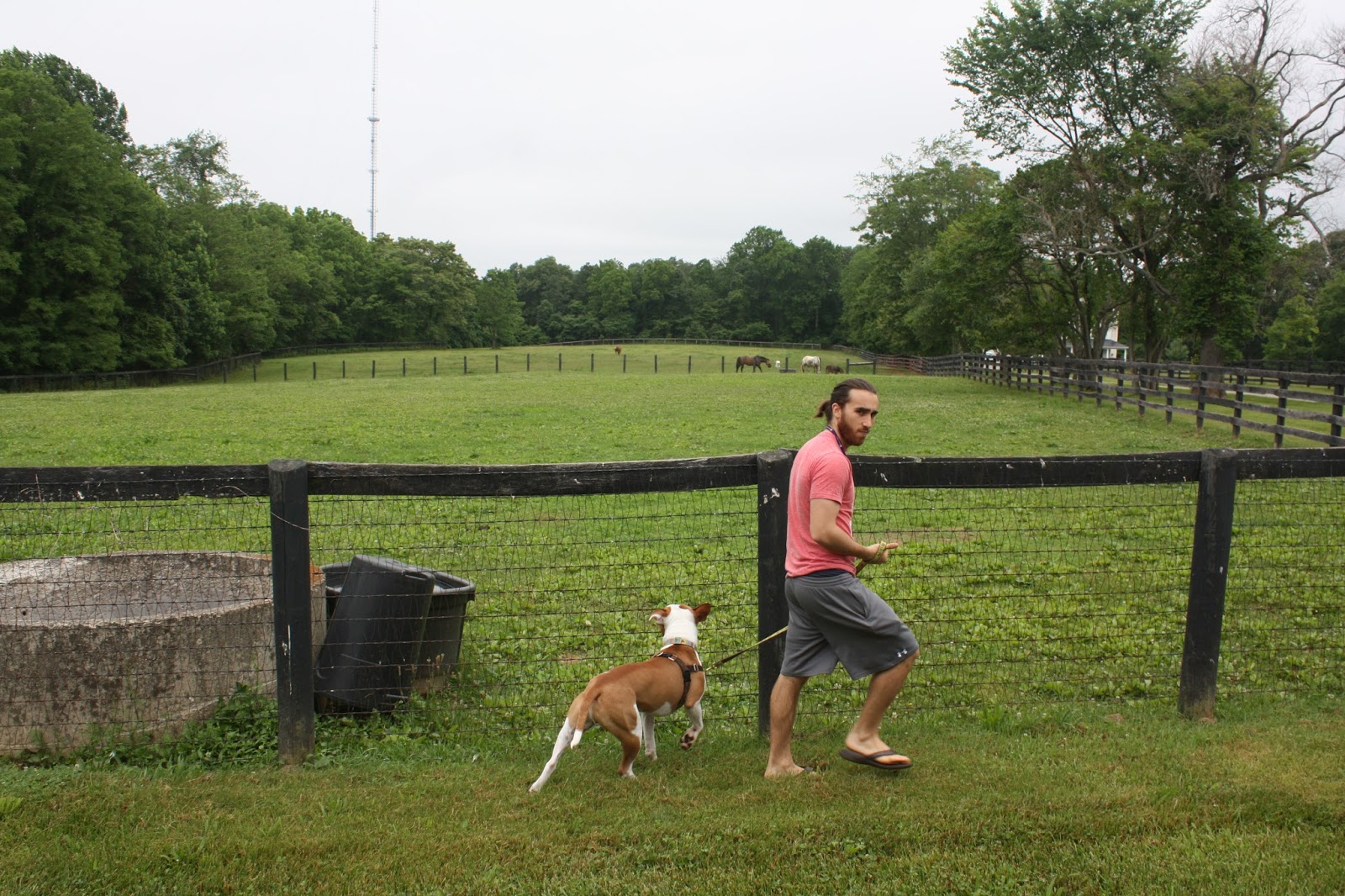
Bandit is like, I'm SURE you don't expect me to do anything with this stuff. He's a city dog.


And here's where we took a bath the previous evening and the outhouse on the right. These photos are the inside of both, which I took from their Airbnb page.


Next, we were off to Charleston, South Carolina with a pitstop in Asheville, NC. Asheville was pretty close to Cosby, I want to say about 1.5 hours away so it wasn't a huge necessity to stop here, but I had wanted to see the city. We didn't stay for very long, but stopped by a coffeeshop so I could charge my phone, which had died the night before in the tipi. 

We ended up choosing Waking Life Espresso for its dog friendly patio and we each had a delicious latte. I really liked the interior too, which was simple and wood-filled. They had individual tables as well as a larger bar table. 


We ate at White Duck Taco Shop, which was a choice I commended myself on. Based on the recommendation of the woman working there, Alex ordered 4 tacos. We were satisfied but not exactly full. We were kind of like, is this how full normal people try to get? I would probably order 5 tacos or even 6 to be shared between two people, but we apparently have gotten used to needing to feel more full than the average person, so.... Alex thought I'd like to see the interior, so took this picture. Meanwhile, Bandit farted in the car while we were waiting for him.


We did stop in Charleston at a pizza place that got high reviews to bring back to our Airbnb which was located outside the city. The pizza was just fine, nothing to write home about. Charleston is definitely somewhere I'd want to spend more time, but we had been before; although I felt like a lot had changed since we visited three years ago. Asheville and Charleston were both very charming cities with too many food options... we'll be back.

We were met by the nicest people in Hanahan, South Carolina. Our hosts had two dogs themselves and were very accommodating of Bandit, played with him, brought him new toys (his favorite toy is any new toy), and even encouraging him to play with their dog to get him some exercise after he had a leg amputated due to cancer. We were surprised that the HUGE backyard was fenced in so it was great to be able to let him off leash while we ate our pizza. This whole place was SO comfortable and clean; it was Alex's favorite of all the places we stayed. The shower was heavenly after a long, hot day. Here are a few pictures from their Airbnb page. I posted a picture of the bathroom because the shower felt that good.

Saturday, September 26, 2015

Chicago to Miami- Day 2 (part 2)

On the second day of our big move, we drove from Louisville/La Grange, KY to Cosby, TN. Although the drive wasn't particularly long, we actually stopped twice on this day, partly because in Tennessee, we would be pretty much as close to the middle of nowhere as one could get. And partially because we thought it might be fun to stop by both Lexington and Knoxville, two cities that we had never been.

Lexington
In Lexington, the place that we originally had planned to eat wasn't open yet, so I did a quick Yelp search and found Stella's Kentucky Deli on the same street, which had a ton of people standing outside. They have an outdoor patio which is dog-friendly, but a little crowded for Bandit's abilities at the time so we ordered takeout and found a table off the sidewalk a little bit down the street.


We grabbed some coffee from A Cup of Commonwealth (really, really good iced latte and iced chai... as in, maybe one of the best) and walked around Thoroughbred Park across the street from the coffeeshop. Bandit was a little nervous of the horses statues at first, but still 100% curious.

And it was really cute how he approached the foal statue that looked he had fallen down while learning how to walk. Bandit was like, "Are you real?"

This picture actually perfectly encapsulates Bandit: incredibly sweet, curious, and lacking any acknowledgment of personal space.

Before this trip, Bandit had probably only been in the car for 1.5-2 hours at a time as we took small trips with him, mostly to visit my parents, or to hike at Starved Rock. He had always been awesome in the car but was definitely more stressed out this time, understandably so: our time in the car was longer, he had less space (since we packed literally everything into my small car), and he had already been stressed out from watching us pack everything. He was honestly really great, even when a pile of clothes fell near him. We aren't experts at traveling with a dog, but we tried to make things easier on him by taking frequent stops. We also packed bully sticks and other random chews for him when we got places (he doesn't chew or play in the car), which he didn't enjoy as much as he normally would. When we got places, he would chew a little and stop, which was also a manifestation of his stress. He was a trooper and did his best to make himself comfortable (although he ignored the easiest way, which would've been to just lay down since we extended his seat). It was sweet the few times we caught him sleeping, although it was few and far between.

Knoxville
I don't have many pictures of Knoxville because it was raining and we mainly wanted to just be able to walk Bandit around and grab some food for dinner at The Tomato Head.

We did, however, get to take him into Urban Outfitters and got some photobooth shots with him. My dream has come true. His dream come true is whenever he is allowed into a store, so he was in heaven too. Until the photobooth thing, at which point he was like WTF. He was too short for the camera unless we helped him keep his head up, which is why it looks like he is being strangled.

Cosby
After Knoxville, we headed for Cosby, TN. During this part of the drive, my phone lost GPS signal, but luckily Alex's phone has never failed us (and we have been to several places that we would expect to lose signal). Our Airbnb for the night was quite a drive. I remember turning off the main road of a small town, then driving through a small residential area (that did have a gas station, convenience store, and Baptist church), and then driving about ten miles beyond that. But it was so cool to be driving along a really nice paved road and see a tipi that was barely visible behind a lining of trees along the road.
On the other side of the road, we followed signs and pulled in. Our hostess was super sweet and showed us all the amenities, including a Norwegian wood stove.
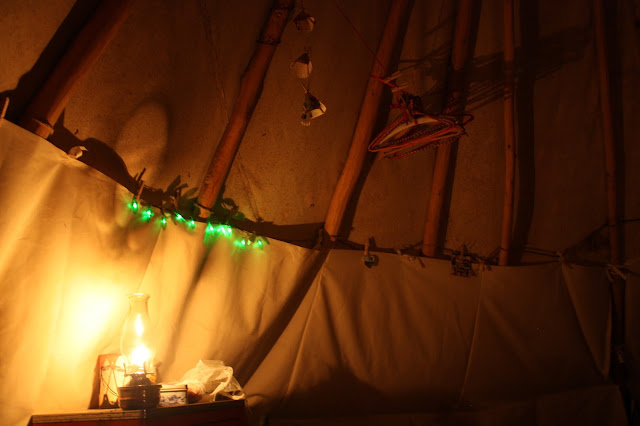
 We used two oil lamps to light the tipi. 
Our hosts lit a wood fire underneath a claw-foot bathtub, which warmed the rain water after about 45 minutes. It was dark by the time the water was hot and Alex and Bandit had already taken a quick nap. I was so nervous Bandit would have a hard time sleeping here, but he seemed to go with the flow beautifully; he slept with us on the cot as well as on the futon.


He wasn't the only sleepy one.
Alex and I took turns bathing. It was amazing to sit in the tub in the dark and look up at the stars. I think that was one of the most unique experiences I've had. 
 Nights like these, I always wonder if city living is all it's cracked up to be.

Thursday, September 17, 2015

we would tell you if we could


This time last year, we had just submitted our applications to residency. Everybody has their own experience; for me, it was a very bittersweet time. It was crazy stressful right before (I did my sub-internship, got letters of recommendation, took Step 2, and then did an away rotation)... but at the same time, there was a sense of calm because I had already done everything I could do by the time I submitted my application and was just waiting for my board exam result. I still have a hard time saying "I'm a doctor" when people ask me what I do. I end up coming up with an awkward "I work at X Hospital" and then it's really weird because they still don't know my occupation.

So I am pretty floored when people are able to eloquently express their thoughts on medicine and ethical issues we encounter, much less literal life and death. I read this article, "How Long Do I Have Left?" by Dr. Paul Kalanithi), my third year of medical school when I was doing my surgery rotation and it stuck with me in a way few articles do. 

AS soon as the CT scan was done, I began reviewing the images. The diagnosis was immediate: Masses matting the lungs and deforming the spine. Cancer. In my neurosurgical training, I had reviewed hundreds of scans for fellow doctors to see if surgery offered any hope. I’d scribble in the chart “Widely metastatic disease — no role for surgery,” and move on. But this scan was different: It was my own.
I have sat with countless patients and families to discuss grim prognoses: It’s one of the most important jobs physicians have. It’s easier when the patient is 94, in the last stages of dementia and has a severe brain bleed. For young people like me — I am 36 — given a diagnosis of cancer, there aren’t many words. My standard pieces include “it’s a marathon, not a sprint, so get your daily rest” and “illness can drive a family apart or bring it together — be aware of each other’s needs and find extra support.”
I learned a few basic rules. Be honest about the prognosis but always leave some room for hope. Be vague but accurate: “days to a few weeks,” “weeks to a few months,” “months to a few years,” “a few years to a decade or more.” We never cite detailed statistics, and usually advise against Googling survival numbers, assuming the average patient doesn’t possess a nuanced understanding of statistics.

People react differently to hearing “Procedure X has a 70 percent chance of survival” and “Procedure Y has a 30 percent chance of death.” Phrased that way, people flock to Procedure X, even though the numbers are the same. When a close friend developed pancreatic cancer, I became the medical maven to a group of people who were sophisticated statisticians. I still dissuaded them from looking up the statistics, saying five-year survival curves are at least five years out of date. Somehow I felt that the numbers alone were too dry, or that a physician’s daily experience with illness was needed for context. Mostly, I felt that impulse: Keep a measure of hope.
These survival curves, called Kaplan-Meier curves, are one way we measure progress in cancer treatment, plotting the number of patients surviving over time. For some diseases, the line looks like an airplane gently beginning its descent; for others, like a dive bomber. Physicians think a lot about these curves, their shape, and what they mean. In brain-cancer research, for example, while the numbers for average survival time haven’t changed much, there’s an increasingly long tail on the curve, indicating a few patients are living for years. The problem is that you can’t tell an individual patient where she is on the curve. It’s impossible, irresponsible even, to be more precise than you can be accurate.
One would think, then, that when my oncologist sat by my bedside to meet me, I would not immediately demand information on survival statistics. But now that I had traversed the line from doctor to patient, I had the same yearning for the numbers all patients ask for. I hoped she would see me as someone who both understood statistics and the medical reality of illness, that she would give me certainty, the straight dope. I could take it. She flatly refused: “No. Absolutely not.” She knew very well I could — and did — look up all the research on the topic. But lung cancer wasn’t my specialty, and she was a world expert. At each appointment, a wrestling match began, and she always avoided being pinned down to any sort of number.
Now, instead of wondering why some patients persist in asking statistics questions, I began to wonder why physicians obfuscate when they have so much knowledge and experience. Initially when I saw my CT scan, I figured I had only a few months to live. The scan looked bad. I looked bad. I’d lost 30 pounds, developed excruciating back pain and felt more fatigued every day. My tests revealed severely low protein levels and low blood counts consistent with the body overwhelmed, failing in its basic drive to sustain itself.
For a few months, I’d suspected I had cancer. I had seen a lot of young patients with cancer. So I wasn’t taken aback. In fact, there was a certain relief. The next steps were clear: Prepare to die. Cry. Tell my wife that she should remarry, and refinance the mortgage. Write overdue letters to dear friends. Yes, there were lots of things I had meant to do in life, but sometimes this happens: Nothing could be more obvious when your day’s work includes treating head trauma and brain cancer.
But on my first visit with my oncologist, she mentioned my going back to work someday. Wasn’t I a ghost? No. But then how long did I have? Silence.
Of course, she could not stop my intense reading. Poring over studies, I kept trying to find the one that would tell me when my number would be up. The large general studies said that between 70 and 80 percent of lung cancer patients would die within two years. They did not allow for much hope. But then again, most of those patients were older and heavy smokers. Where was the study of nonsmoking 36-year-old neurosurgeons? Maybe my youth and health mattered? Or maybe my disease was found so late, had spread so far, and I was already so far gone that I was worse off than those 65-year-old smokers.
Many friends and family members provided anecdotes along the lines of my-friend’s-friend’s-mom’s-friend or my-uncle’s-barber’s-son’s-tennis-partner has this same kind of lung cancer and has been living for 10 years. Initially I wondered if all the stories referred to the same person, connected through the proverbial six degrees. I disregarded them as wishful thinking, baseless delusion. Eventually, though, enough of those stories seeped in through the cracks of my studied realism.
And then my health began to improve, thanks to a pill that targets a specific genetic mutation tied to my cancer. I began to walk without a cane and to say things like, “Well, it’s pretty unlikely that I’ll be lucky enough to live for a decade, but it’s possible.” A tiny drop of hope.
In a way, though, the certainty of death was easier than this uncertain life. Didn’t those in purgatory prefer to go to hell, and just be done with it? Was I supposed to be making funeral arrangements? Devoting myself to my wife, my parents, my brothers, my friends, my adorable niece? Writing the book I had always wanted to write? Or was I supposed to go back to negotiating my multiyear job offers?
The path forward would seem obvious, if only I knew how many months or years I had left. Tell me three months, I’d just spend time with family. Tell me one year, I’d have a plan (write that book). Give me 10 years, I’d get back to treating diseases. The pedestrian truth that you live one day at a time didn’t help: What was I supposed to do with that day? My oncologist would say only: “I can’t tell you a time. You’ve got to find what matters most to you.”
I began to realize that coming face to face with my own mortality, in a sense, had changed both nothing and everything. Before my cancer was diagnosed, I knew that someday I would die, but I didn’t know when. After the diagnosis, I knew that someday I would die, but I didn’t know when. But now I knew it acutely. The problem wasn’t really a scientific one. The fact of death is unsettling. Yet there is no other way to live.
The reason doctors don’t give patients specific prognoses is not merely because they cannot. Certainly, if a patient’s expectations are way out of the bounds of probability — someone expecting to live to 130, or someone thinking his benign skin spots are signs of impending death — doctors are entrusted to bring that person’s expectations into the realm of reasonable possibility.
But the range of what is reasonably possible is just so wide. Based on today’s therapies, I might die within two years, or I might make it to 10. If you add in the uncertainty based on new therapies available in two or three years, that range may be completely different. Faced with mortality, scientific knowledge can provide only an ounce of certainty: Yes, you will die. But one wants a full pound of certainty, and that is not on offer.
What patients seek is not scientific knowledge doctors hide, but existential authenticity each must find on her own. Getting too deep into statistics is like trying to quench a thirst with salty water. The angst of facing mortality has no remedy in probability.
I remember the moment when my overwhelming uneasiness yielded. Seven words from Samuel Beckett, a writer I’ve not even read that well, learned long ago as an undergraduate, began to repeat in my head, and the seemingly impassable sea of uncertainty parted: “I can’t go on. I’ll go on.” I took a step forward, repeating the phrase over and over: “I can’t go on. I’ll go on.” And then, at some point, I was through.
I am now almost exactly eight months from my diagnosis. My strength has recovered substantially. In treatment, the cancer is retreating. I have gradually returned to work. I’m knocking the dust off scientific manuscripts. I’m writing more, seeing more, feeling more. Every morning at 5:30, as the alarm clock goes off, and my dead body awakes, my wife asleep next to me, I think again to myself: “I can’t go on.” And a minute later, I am in my scrubs, heading to the operating room, alive: “I’ll go on.”

Today I stumbled across the fact that this physician died this year. And I found another article he wrote, entitled Before I Go, which I also felt was very poignant.

In residency, there’s a saying: The days are long, but the years are short. In neurosurgical training, the day usually began a little before 6 a.m., and lasted until the operating was done, which depended, in part, on how quick you were in the OR.

A resident’s surgical skill is judged by his technique and his speed. You can’t be sloppy and you can’t be slow. From your first wound closure onward, spend too much time being precise and the scrub tech will announce, “Looks like we’ve got a plastic surgeon on our hands!” Or say: “I get your strategy — by the time you finish sewing the top half of the wound, the bottom will have healed on its own. Half the work — smart!” A chief resident will advise a junior: “Learn to be fast now — you can learn to be good later.” Everyone’s eyes are always on the clock. For the patient’s sake: How long has the patient been under anesthesia? During long procedures, nerves can get damaged, muscles can break down, even causing kidney failure. For everyone else’s sake: What time are we getting out of here tonight?

There are two strategies to cutting the time short, like the tortoise and the hare. The hare moves as fast as possible, hands a blur, instruments clattering, falling to the floor; the skin slips open like a curtain, the skull flap is on the tray before the bone dust settles. But the opening might need to be expanded a centimeter here or there because it’s not optimally placed. The tortoise proceeds deliberately, with no wasted movements, measuring twice, cutting once. No step of the operation needs revisiting; everything proceeds in orderly fashion. If the hare makes too many minor missteps and has to keep adjusting, the tortoise wins. If the tortoise spends too much time planning each step, the hare wins.

The funny thing about time in the OR, whether you frenetically race or steadily proceed, is that you have no sense of it passing. If boredom is, as Heidegger argued, the awareness of time passing, this is the opposite: The intense focus makes the arms of the clock seem arbitrarily placed. Two hours can feel like a minute. Once the final stitch is placed and the wound is dressed, normal time suddenly restarts. You can almost hear an audible whoosh. Then you start wondering: How long till the patient wakes up? How long till the next case gets started? How many patients do I need to see before then? What time will I get home tonight?

It’s not until the last case finishes that you feel the length of the day, the drag in your step. Those last few administrative tasks before leaving the hospital, however far post-meridian you stood, felt like anvils. Could they wait till tomorrow? No. A sigh, and Earth continued to rotate back toward the sun.
But the years did, as promised, fly by. Six years passed in a flash, but then, heading into chief residency, I developed a classic constellation of symptoms — weight loss, fevers, night sweats, unremitting back pain, cough — indicating a diagnosis quickly confirmed: metastatic lung cancer. The gears of time ground down. While able to limp through the end of residency on treatment, I relapsed, underwent chemo and endured a prolonged hospitalization.

I emerged from the hospital weakened, with thin limbs and thinned hair. Now unable to work, I was left at home to convalesce. Getting up from a chair or lifting a glass of water took concentration and effort. If time dilates when one moves at high speeds, does it contract when one moves barely at all? It must: The day shortened considerably. A full day’s activity might be a medical appointment, or a visit from a friend. The rest of the time was rest.

With little to distinguish one day from the next, time began to feel static. In English, we use the word time in different ways, “the time is 2:45” versus “I’m going through a tough time.” Time began to feel less like the ticking clock, and more like the state of being. Languor settled in. Focused in the OR, the position of the clock’s hands might seem arbitrary, but never meaningless. Now the time of day meant nothing, the day of the week scarcely more so.

Verb conjugation became muddled. Which was correct? “I am a neurosurgeon,” “I was a neurosurgeon,” “I had been a neurosurgeon before and will be again”? Graham Greene felt life was lived in the first 20 years and the remainder was just reflection. What tense was I living in? Had I proceeded, like a burned-out Greene character, beyond the present tense and into the past perfect? The future tense seemed vacant and, on others’ lips, jarring. I recently celebrated my 15th college reunion; it seemed rude to respond to parting promises from old friends, “We’ll see you at the 25th!” with “Probably not!”

Yet there is dynamism in our house. Our daughter was born days after I was released from the hospital. Week to week, she blossoms: a first grasp, a first smile, a first laugh. Her pediatrician regularly records her growth on charts, tick marks of her progress over time. A brightening newness surrounds her. As she sits in my lap smiling, enthralled by my tuneless singing, an incandescence lights the room.

Time for me is double-edged: Every day brings me further from the low of my last cancer relapse, but every day also brings me closer to the next cancer recurrence — and eventually, death. Perhaps later than I think, but certainly sooner than I desire. There are, I imagine, two responses to that realization. The most obvious might be an impulse to frantic activity: to “live life to its fullest,” to travel, to dine, to achieve a host of neglected ambitions. Part of the cruelty of cancer, though, is not only that it limits your time, it also limits your energy, vastly reducing the amount you can squeeze into a day. It is a tired hare who now races. But even if I had the energy, I prefer a more tortoiselike approach. I plod, I ponder, some days I simply persist.

Everyone succumbs to finitude. I suspect I am not the only one who reaches this pluperfect state. Most ambitions are either achieved or abandoned; either way, they belong to the past. The future, instead of the ladder toward the goals of life, flattens out into a perpetual present. Money, status, all the vanities the preacher of Ecclesiastes described, hold so little interest: a chasing after wind, indeed.
Yet one thing cannot be robbed of her futurity: my daughter, Cady. I hope I’ll live long enough that she has some memory of me. Words have a longevity I do not. I had thought I could leave her a series of letters — but what would they really say? I don’t know what this girl will be like when she is 15; I don’t even know if she’ll take to the nickname we’ve given her. There is perhaps only one thing to say to this infant, who is all future, overlapping briefly with me, whose life, barring the improbable, is all but past.

That message is simple: When you come to one of the many moments in life when you must give an account of yourself, provide a ledger of what you have been, and done, and meant to the world, do not, I pray, discount that you filled a dying man’s days with a sated joy, a joy unknown to me in all my prior years, a joy that does not hunger for more and more, but rests, satisfied. In this time, right now, that is an enormous thing.

Wednesday, August 26, 2015

Chicago to Miami- Day 2 (part 1)


We woke up in LaGrange, Kentucky feeling pretty refreshed and ready to take on the day. We wanted to spend some time exploring the land around our cabin. The owners lived on the property in a house; there was also a much larger, gorgeous cabin near us. I think it was at this point that Bandit finally began feeling like hey, we are having a lot of fun because there are horses here and I haven't been thrown to the side of the road yet! 

Day 2
Destination: LaGrange, KY to Cosby, TN
Stops: Lexington, KY and Knoxville, TN

 Bandit saw a horse one time who was pulling a Santa carriage in Normal, IL and he has been in love ever since. Really though, there hasn't been an animal (beetles included) that he hasn't totally loved. The second he saw them, the Bandit thought process began. First comes the stare rudely and contemplate the next move (even though there is really only one next move):


Next is the army crawl, the go-to move for being sneaky and camouflage:
And finally comes the reward: making friends!
His curiosity about everyone and friendliness will always amaze me.

Sunday, August 23, 2015

Chicago to Miami- Day 1

In late May/early June, we moved from Chicago to Miami. Because we had our omnipresent buddy Bandit, we wanted to split up the trip into several days to make it a little easier on both him and us being in the car so long. He was certainly the thing we thought about most during the journey. In the days leading up to the trip, he was stressed out watching us pack everything up. I can't even begin to imagine what he was thinking and it breaks my heart to think that he might've thought we were leaving him.

We ended up booking places to stay on Airbnb, which I think made the trip a lot more fun than staying in hotels. Since we had the dog, we focused our trip on finding dog-friendly places that would be fun, rather than planning a ton of activities. We knew that we had to get to Miami before June 8, but other than that, we didn't have many restrictions... so, ridiculously, the trip ended up being planned around the availability of a tipi that I wanted to stay in.

Day 1
Alex loaded everything up in the car as I did last-minute packing and my parents came to see us off. My mom packed a ton of fruit for us, which was a life saver to have as a snack on the road. Growing up, my mom always washed and cut fruit for us after dinner and before bed, which is a tradition that I always loved. Most of our drive was gloomy and rainy, but it actually ended up being perfect road trip weather, except for when it was pouring to the point that we couldn't see the road.

Final destination: LaGrange, Kentucky
Stops along the way: Indianapolis (for a stressed out dog) and Louisville, KY (for food purposes)


Our first stop was about 3.5 hours in, at Indianapolis. We were feeling pretty sleepy so we found a coffeeshop, which turned out to be closed. Most places were closed, but we were able to stretch our legs a little bit and found a few places to hopefully check out "next time," although I admit that I don't necessarily hope to find myself in Indianapolis in the near future, charming as it may be. The theme of the trip was balancing the heat with being able to spend enough time walking and decompressing as well as finding quiet areas for the dog. This is his "I love Indianapolis!" face.
Much of the rest of the midwest was idyllic.

We stopped in a bar/restaurant called Hammerheads that had good reviews on Yelp. They don't typically allow takeout unless you have a really small party and actually show up and look sad because they have a small kitchen. They told us differently on the phone when we had called in so they let us place an order. The place was packed, despite the fact there was no air conditioning, which I considered a good sign... if you are willing to be in a stuffy place, the food must be worth writing home about. We walked around Louisville and met some cats while we waited. They were super accepting of Bandit and brought out a water bowl just for him.

We arrived at our cabin in LaGrange a bit later than expected (another theme of the trip), but it was a really cool cabin--and comfortable. We ate on the porch and Bandit enjoyed one of the Barkworthies treats I brought for him on this trip.
I loved my mushroom veggie burger and truffle fries; Bandit didn't love the Cocolicious wet food we brought for him as much as I thought he would. Based on his usual love for wet food and coconut oil as separate entities, I thought he would be obsessed with this stuff, but as excited as he looked in that first picture when I let him smell it, he still didn't finish all of the food right away. Of course, he was also really stressed out that first night. Which is fair. He was all, "Why are we in a cabin in the middle of nowhere in Kentucky?"
I love the peace and quiet of the place, as did Alex, although he did think it seemed haunted since it was pitch black outside and sooo quiet. It was a nice change from the light shining into our bedroom window in Chicago. And sleeping in a king bed with Bandit... so luxurious, words can't even describe it. We got an amazing night of sleep!